
A sales tax invoice in Pakistan must carry seven particulars set out in Section 23 of the Sales Tax Act 1990: the supplier's details, the buyer's details, the date, a description and quantity, the value excluding tax, the tax amount, and the value including tax. It has to be serially numbered, issued at the time of supply, and written in Urdu or English. If you are inside FBR's digital invoicing regime, it must also bear a verifiable and unique FBR invoice number. Getting it wrong now costs PKR 25,000 or five per cent of the tax involved, whichever is higher.
That is the whole answer. What follows is each field, where it comes from in the law, and the parts that most published guidance still gets wrong.
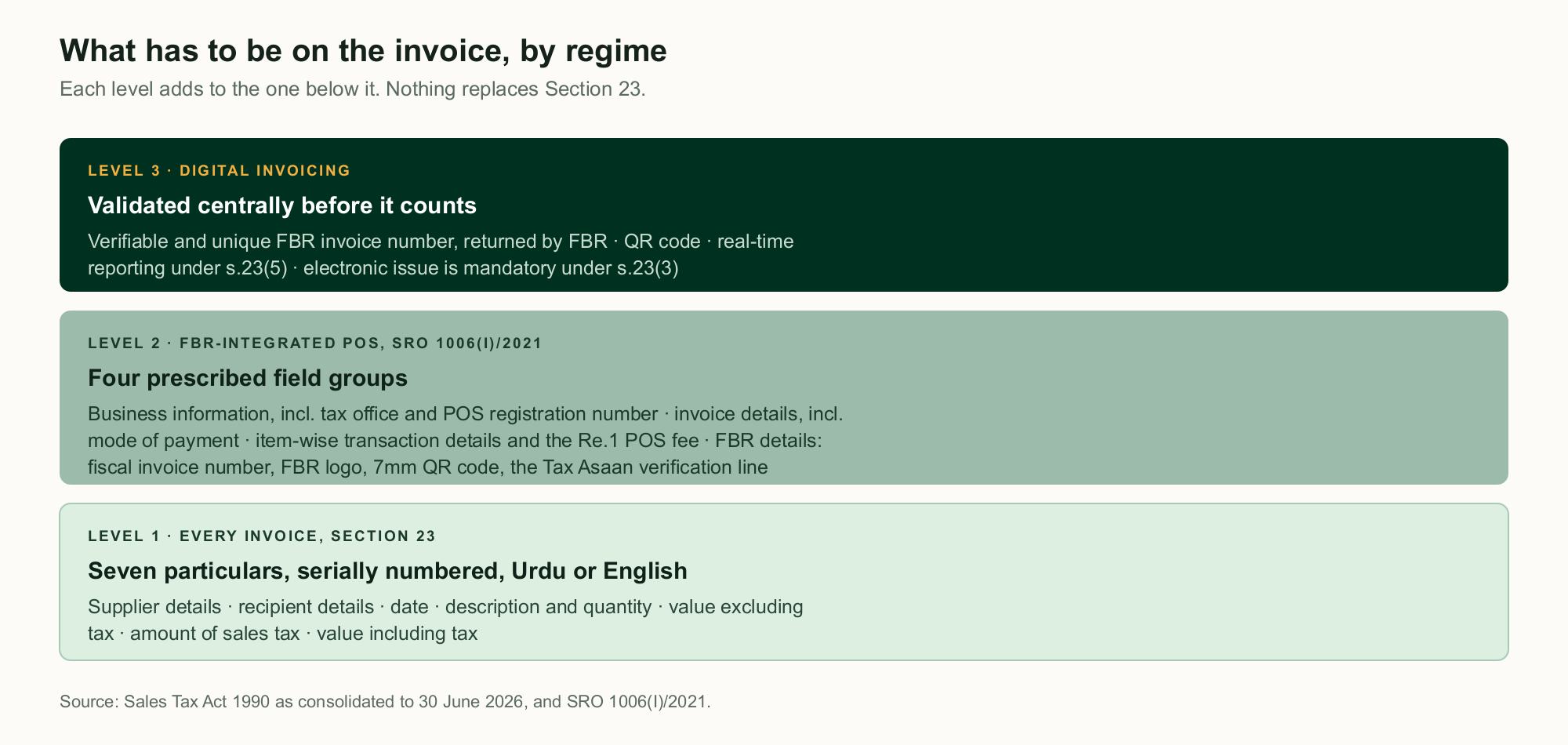
Three levels, and each one adds to the level below. Section 23 applies to every invoice, whatever else you are subject to.
What does the law actually require on a sales tax invoice?
Section 23(1) is the source. Everything else, including the POS format and the digital invoicing rules, hangs off it. The current text, as consolidated to 30 June 2026, requires a registered person making a supply to issue a serially numbered tax invoice at the time of supply of goods, in Urdu or English, containing these particulars.
| Clause | What it requires |
|---|---|
| (a) | Name, address and registration number of the supplier |
| (b) | Name, address and registration number of the recipient, and for supplies by a manufacturer or importer to an unregistered distributor, that distributor's NIC or NTN |
| (c) | Date of issue of invoice |
| (d) | Description and quantity of goods, including count, denier and construction for textile yarn and fabric |
| (e) | Value exclusive of tax |
| (f) | Amount of sales tax |
| (g) | Value inclusive of tax |
Two rules sit underneath that list and are easy to miss. The first is that no more than one tax invoice may be issued for a taxable supply. If you reprint, you are reprinting the same invoice, not issuing a second one, and your system needs to treat those differently. The second, added by the Finance Act 2025, is that where goods are transported or supplied, the tax invoice has to be generated and linked to the e-Bilty raised under Section 40C of the Act and Section 83C of the Customs Act 1969. That turns the invoice from a standalone document into something tied to a movement record.
Section 23(2) is worth knowing too: only a registered person, or a person paying retail tax, may issue an invoice under this section at all.
What changed for 2026?
The Finance Act 2026 rewrote the opening words of Section 23(1), and the change is larger than it looks. Three things moved.
Exempt supplies now need an invoice. The clause used to bite on a registered person making a taxable supply. It now reads "taxable as well as exempt supply". If you sell exempt goods and have been issuing a delivery note or a plain commercial invoice, that is no longer sufficient.
Advance receipt invoices are inside the section. The obligation now expressly covers an advance receipt invoice, with a proviso letting FBR notify which persons or classes may issue one within the notified system. If you take deposits or advance payments, the receipt is now invoice-shaped and has to be linked to the final document.
The invoice must bear a verifiable and unique FBR invoice number. This is the headline change, and it carries an important qualifier that most summaries drop: a further proviso states that this condition applies from the time as notified by the Board. So the requirement is in the statute, and the date it starts biting for your category is a matter of notification. Check your own category on FBR's portal rather than assuming a date from a vendor blog.
Do you need the buyer's CNIC on the invoice?
Usually not, and this is where published guidance is most often out of date. A great many articles still state that Section 23 requires a buyer's CNIC once an invoice passes PKR 100,000. The current clause (b) does not say that.
What it requires is the recipient's name, address and registration number, and then a narrower rule: where a manufacturer or importer supplies an unregistered distributor, the invoice must carry that distributor's NIC or NTN. It is a targeted anti-leakage provision aimed at the distribution chain, not a general rule about consumers. Clause (b) was substituted by the Finance Act 2022, which is why pre-2022 commentary reads so differently.
The PKR 100,000 figure is real, but it belongs somewhere else. It sits in the POS invoice format described below, where the buyer's name is recorded if the customer is liable for the tax or the invoice value is above that amount. One curiosity in the drafting: the Explanation defining an "ordinary consumer" still survives under clause (b) even though the clause no longer uses the term. If your finance team is arguing about CNIC capture, read the clause itself before building the field as mandatory.
What does an FBR-integrated POS invoice add?
If you are a retailer issuing invoices through a POS integrated with FBR, the field list is longer. SRO 1006(I)/2021, issued on 9 August 2021 under the first proviso to Section 23(1), sets a standardised format in four groups. Everything in it has to be clearly printed on every invoice.
Business information. Business or brand name, the complete address of that business location, your STRN and NTN, the name of the tax office or formation you are registered at, and the unique POS registration number for that till.
Invoice details. A unique sequential invoice number, the date and time of sale, and the mode of payment, meaning cash, credit or debit card, cheque or gift voucher. The buyer's name is optional for business-to-business sales, and recorded where the customer is liable for the tax or the invoice value is above PKR 100,000.
Transaction details. Item-wise description and unit price excluding tax, the tax rate for each item with zero per cent applied where an item is exempt, item-wise quantity, tax amount, total sale value, tax charged on the invoice, discounts if any, the POS service fee of one rupee per invoice, total payable and total received.
FBR details. The FBR fiscal invoice number in the format XXXXXX-DDMMYYHHMMSS-0001, the FBR POS invoicing system logo, a verifiable QR code at 7mm by 7mm, and this statement in a legible font and size: "Verify this invoice through FBR Tax Asaan Mobile App or SMS at 9966 and win exciting prizes in draw".
The two specifications people underestimate are the QR dimensions and the fiscal number format. Both are prescriptive, and a receipt printer with the wrong column width will silently break them.
What does digital invoicing add on top of that?
Section 23 now carries two sub-sections that did not matter much a few years ago. Sub-section (3) says a registered person making a taxable supply shall issue electronic invoices, subject to conditions FBR specifies, where the older wording was permissive. Sub-section (5) lets FBR require any person or class of persons to integrate their electronic invoicing system with the Board's Computerized System for real-time reporting of sales.
In practice that means the invoice is validated centrally before it is a valid invoice. You transmit, FBR returns an invoice number and a QR code, and your document carries both. A correct-looking invoice that never reached FBR is not the same document in the eyes of the law, which is why a scanned or handwritten copy does not satisfy the regime however accurate its arithmetic.
How that connection is actually built, through PRAL or a licensed integrator, and what it does to your month-end, is a longer subject. We covered it separately in what FBR digital invoicing integration actually involves, and the implementation side sits on our POS and FBR digital invoicing integration page.
Why does textile yarn and fabric need extra description?
Clause (d) requires a description and quantity of goods, and then singles out one sector: for textile yarn and fabric, the description must include count, denier and construction. That wording was added by the Finance Act 2019.
It is a small clause with real consequences for a mill. A generic item master that holds "grey fabric" as one line cannot produce a compliant invoice, because count, denier and construction are attributes of the specific material and have to appear on the document. In practice this pushes the detail back into the item master or into structured attributes on the sales line, which is a system design question rather than a printing question. It is one of the reasons textile manufacturing systems tend to need more work on the item model than other sectors.
What is the penalty if the invoice is wrong or missing?
Section 33 sets the amounts, and the Finance Act 2026 raised two of them.
| Offence | Penalty |
|---|---|
| Failing to issue an invoice when required | PKR 25,000 or 5% of the tax involved, whichever is higher |
| Issuing an invoice showing tax without authority | PKR 50,000 or 10% of the tax involved, whichever is higher |
| Failing to integrate, or failing to issue electronic invoices after integration | PKR 500,000 first default, then 1 million, 2 million and 3 million for successive defaults |
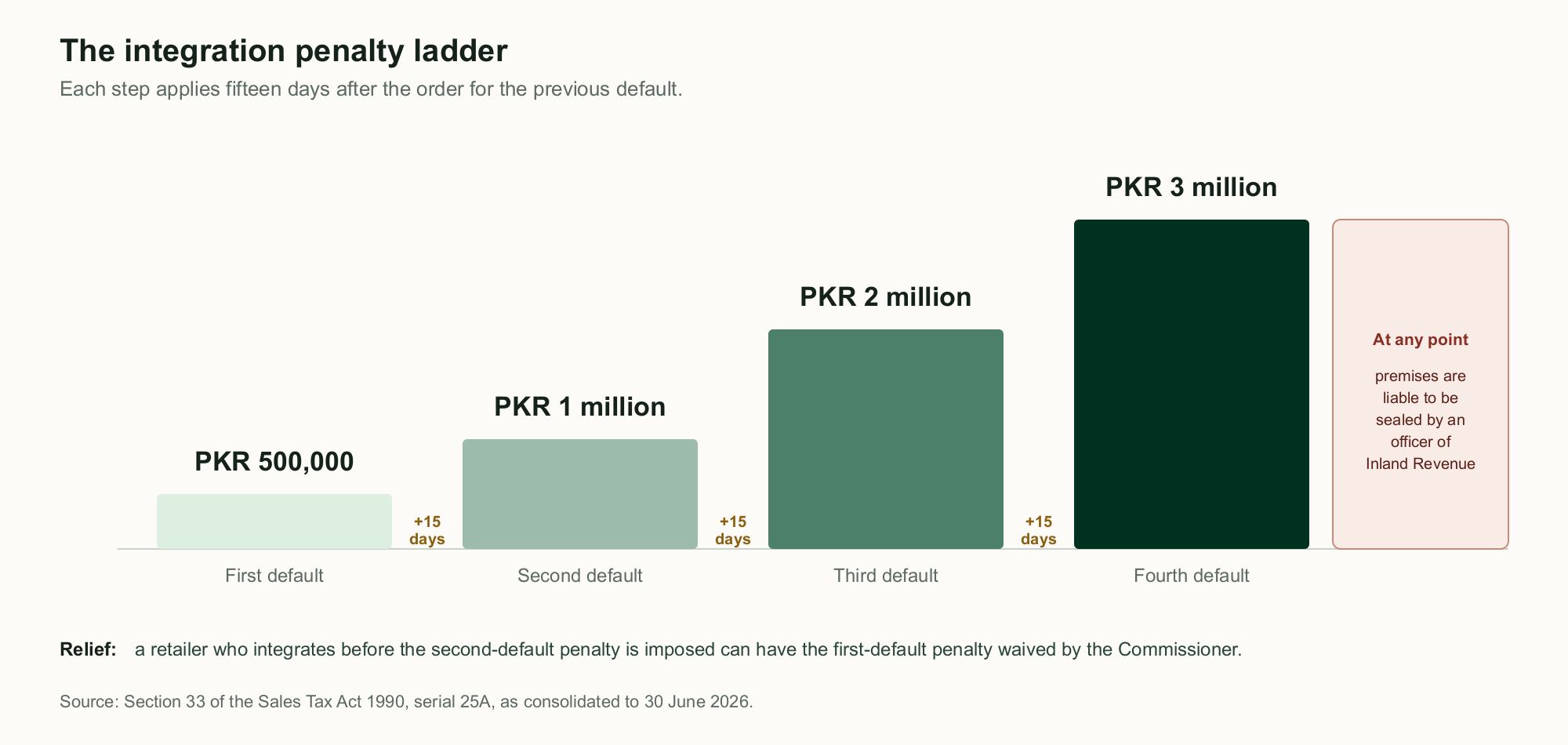
The ladder for failing to integrate. The amounts climb quickly, and sealing is available at any point on it.
The integration ladder deserves a closer look, because it is not only money. Each step up applies after fifteen days from the order for the previous default, and the schedule adds that regardless of the penalties, the business premises are liable to be sealed by an officer of Inland Revenue. There is one piece of relief: a retailer who integrates before the second-default penalty is imposed can have the first-default penalty waived by the Commissioner.
Separately, a licensed integrator that fails to integrate registered persons as required faces a penalty of PKR 1 million or one per cent of the total value of sales suppressed, whichever is higher. Worth knowing if you are choosing a vendor, since it tells you the law puts weight on their side of the arrangement too.
How long do you have to keep invoices?
Six years. Section 24 requires anyone who must maintain records under the Act to retain them for six years after the end of the tax period they relate to, and longer if proceedings are still running, including assessment, appeal, revision, reference, petition or anything before an Alternative Dispute Resolution Committee.
For a system, six years is the floor and the open-proceedings clause is the part that bites, because it has no fixed end date. Archive policies built on a flat six-year purge can delete records that are still required.
One thing worth saying plainly
If you are not yet in a notified category for the FBR invoice number, and your invoice volume is modest, do not buy invoicing middleware this quarter. The fields in Section 23 can be satisfied by almost any competent accounting system, and the expensive part of digital invoicing is not the connection, it is cleaning up an item master and a customer master that were never built to carry registration numbers, NTNs and structured item attributes. That work is worth doing now because it is required either way. The integration can wait for your actual date.
If the master data cleanup is the real problem, that is an ERP integration and interfaces question, and it tends to arrive bundled with the budget questions we covered in ERP implementation costs in Pakistan.
Every field, SRO reference and penalty figure above is taken from FBR's own documents: the Sales Tax Act 1990 as consolidated to 30 June 2026 and SRO 1006(I)/2021. For the digital invoicing framework under SRO 69(I)/2025, EY's summary of Pakistan's amended sales tax rules for electronic invoicing is a reliable non-vendor account. Tax law changes: confirm dates and your own category against FBR before acting on any guide, including this one.