
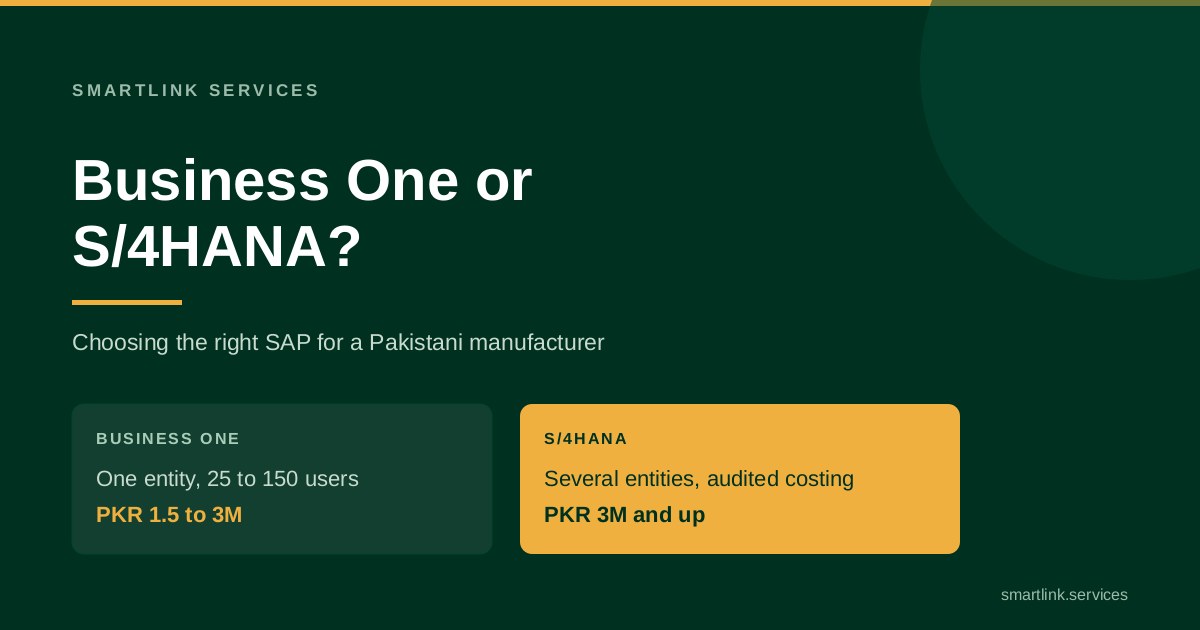
For a Pakistani manufacturer, the choice between SAP Business One and S/4HANA is decided by how many legal entities you have to report, not by how many people will use the system. One entity with standard make-and-sell processes belongs on Business One, in the PKR 1.5 to 3 million implementation band, live in three to four months. Several entities that have to consolidate, with costing that will be audited, belong on S/4HANA, from PKR 3 million upward, with reported timelines of nine to twelve months.
Everything else in the comparison is detail. Below is the detail, including the places where the obvious answer is wrong.
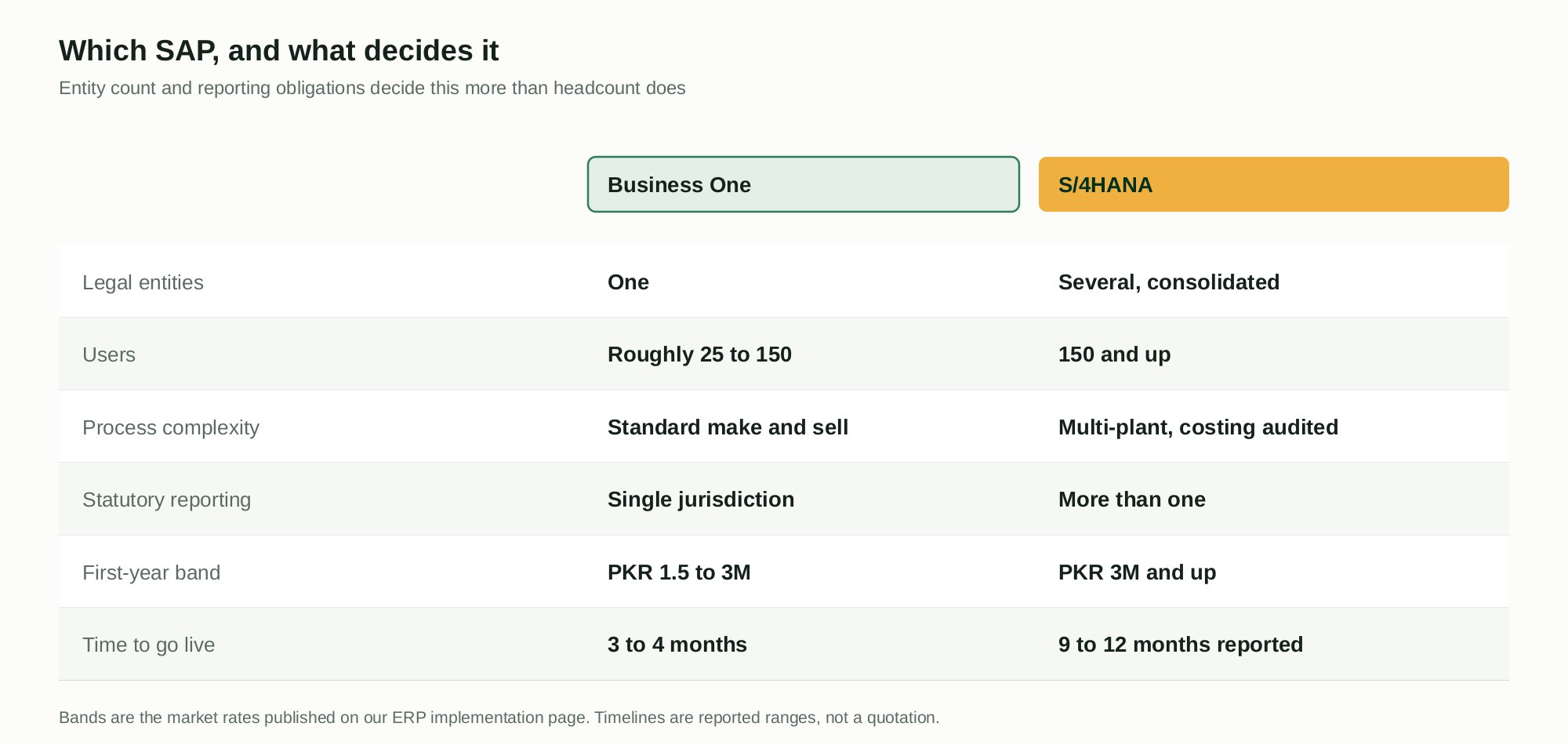
Why entity count decides this, not headcount
Vendor comparisons usually lead with employee ranges, which is why so many Pakistani manufacturers end up looking at the wrong product. Headcount tells you how many licences you need. It says nothing about the work.
The work is set by structure. Every additional legal entity brings its own chart of accounts, its own statutory reporting, and intercompany transactions that have to eliminate cleanly at consolidation. That is the problem S/4HANA is built for, and it is the problem Business One handles only with workarounds that start out acceptable and end up load bearing.
A 300-person single-entity mill with one plant and straightforward costing is comfortably a Business One customer. A 120-person group with three companies, intercompany trade and an auditor who asks how standard cost was derived is not, whatever the headcount suggests.
Where Business One is the right answer
Business One suits a single legal entity running recognisable processes: buy, make, stock, sell, invoice, collect. Finance, inventory, production and sales in one system, with a shop floor that confirms against production orders rather than one that needs a full manufacturing execution layer.
It is also the right answer when the decisive constraint is time. Three to four months to a working system changes what a business can do this year. A programme that reaches go-live in month ten has to be worth the wait, and often is not.
Two limits to know before you commit. Process manufacturing with recipes, yields and co-products is where Business One starts needing add-ons, and an add-on is a third party in your upgrade path. Multi-entity consolidation is the other: possible, but you will feel it at every month end.
Where S/4HANA earns its cost
S/4HANA earns it when the questions being asked of the system are structural: what did this actually cost to make, across which plants, under which valuation method, and can that be defended to an auditor. Costing depth, multi-entity consolidation and statutory reporting in more than one jurisdiction are what you are buying.
It also earns it when the business expects to change shape. A group that will acquire, add a plant or enter another market within three years is better served by a platform designed for that than by a system it will outgrow at an awkward moment.
The honest counterweight: S/4HANA demands discipline from the business, not only from the project. It expects processes to be defined and followed. Organisations that run on exceptions and verbal approvals find that the system does not bend, and the cost of that discovery is paid in month seven.
What each one costs here
Implementation effort in Pakistan falls into three market bands, and SAP work sits in the upper two almost every time. A mid-sized programme of five to seven modules with a mobile application sits at PKR 1,500,000 to 3,000,000 across three to four months. Multi-location work with manufacturing and external integrations starts at PKR 3,000,000 and runs four to six months or longer. Reported timelines put a focused single-company go-live at six to twelve weeks, an SME rollout at three to six months and a large enterprise programme at nine to twelve months, with SAP landing at the long end more often than not.
Module add-ons are the line buyers price first: accounting and finance at PKR 200,000 to 400,000, HR and payroll the same, manufacturing at PKR 300,000 to 600,000, and multi-location capability at PKR 200,000 to 500,000.
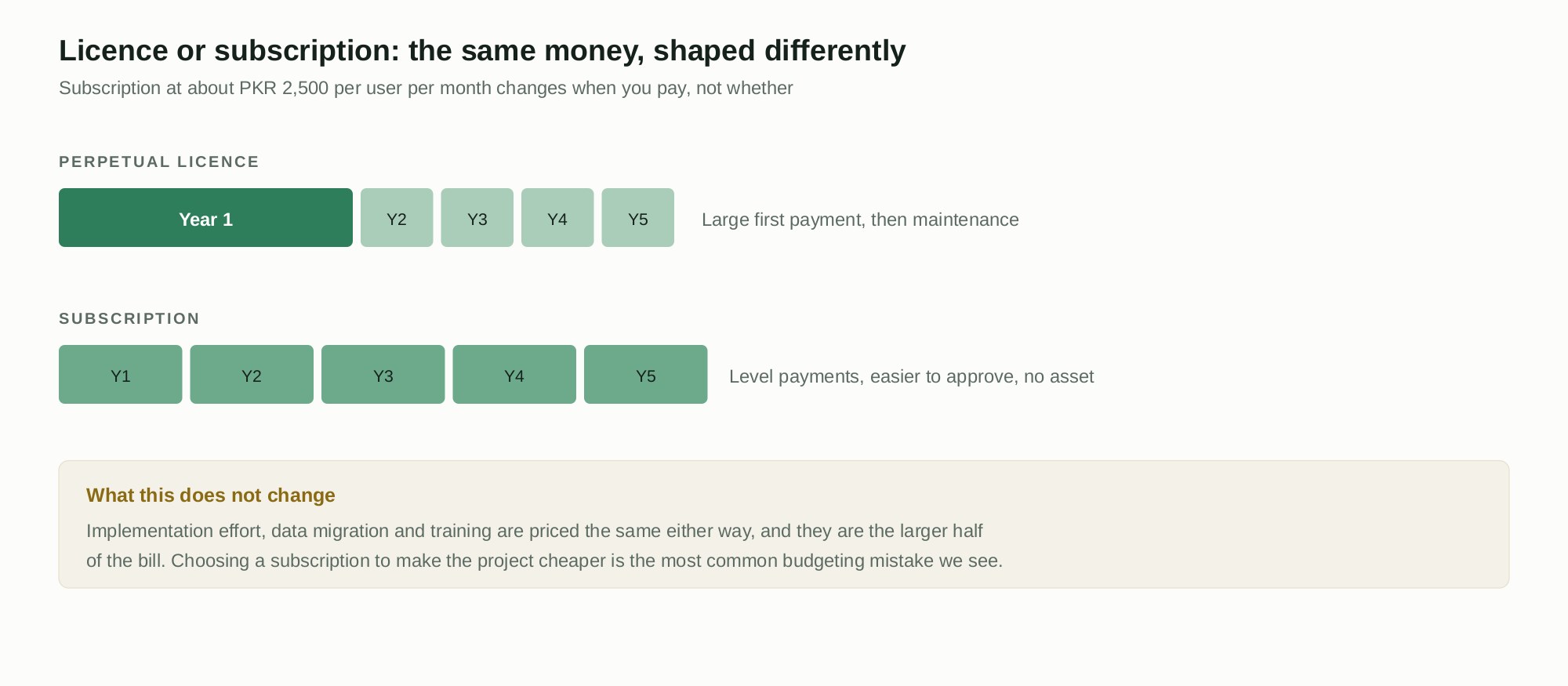
Where the platform is sold by subscription rather than licence, the market figure is around PKR 2,500 per user per month. That changes the shape of the spend without changing its size, and it is worth being clear-eyed about: choosing a subscription does not make the project cheaper, it makes the first invoice smaller.
The questions that actually separate the two
Work through these before looking at a single demo. They decide the answer faster than any feature matrix.
- How many legal entities file separately, and do they trade with each other? Two or more with intercompany trade points to S/4HANA.
- Will your costing be audited, and against what method? If you cannot state the method today, that conversation is the project, whichever platform you pick.
- Is your manufacturing discrete or process? Recipes, yields and co-products push Business One towards add-ons.
- How many plants, and will they share a template? One template repeated is a rollout; three different ways of working is three projects.
- Who signs the functional design? Name the person. Projects that go badly are rarely short of effort, they are short of agreement.
- What happens to the business if go-live is month ten rather than month four? If the answer is nothing much, you have room for the larger platform.
The mistakes that cost the most
Buying the platform your auditor's other client uses. Their structure is not yours. The only transferable part of that recommendation is the implementer, and even that depends on who is actually assigned.
Treating the enterprise structure as a naming exercise. Company code, controlling area, valuation area, plant, storage location, sales organisation and purchasing organisation get decided in the first weeks, when the project knows least about itself, and they are expensive to revisit two years of postings later. This is the first real gate, not a formality.
Customising to avoid a decision. Fit and gap produces a list, and each item ends in one of three ways: change the process, accept standard behaviour, or build something. Building carries a tail, because every custom object is retested at each upgrade for the life of the system.
Underestimating data. If the item master has inconsistent units, duplicate codes or no tariff codes, that is a project before it is an implementation, on either platform. It is also the single most common reason a realistic plan becomes a late one.
What the module footprint actually differs on
Both platforms cover finance, purchasing, inventory, sales and production. The difference is depth in three places, and those three are where manufacturers feel it.
Costing. Business One gives you item cost by valuation method and a workable picture of margin. S/4HANA gives you a controlling layer: cost centres, activity types, work centre rates, variance analysis split into price, quantity and usage. If anyone in your business argues about why a product cost what it cost, that argument has a home in the second system and not really in the first.
Production. Discrete assembly against production orders works in both. Process manufacturing with recipes, co-products and yield variances is where Business One reaches for add-ons. Add-ons work, and they also mean a third party sits inside your upgrade path.
Quality. Inspection lots, sampling plans and certificates of analysis tied to batches are standard in the larger platform. In Business One they are usually a bolt-on or a parallel spreadsheet, and the spreadsheet is the one that fails an audit.
For most Pakistani manufacturers the practical test is whether quality and costing are commercially material. If a customer or a regulator asks for batch traceability with documented inspection, treat that as a vote for the larger platform regardless of size.
Licensing mechanics worth understanding before you negotiate
User counts are not a single number. Both platforms distinguish between users who do everything and users who only record or only read, and the mix drives the licence bill more than the headline total does.
Count your population by what people actually do. A plant with 200 staff rarely needs 200 full users: the store keeper who confirms goods receipts, the operator who confirms production and the supervisor who approves are three different licence conversations. Getting this wrong in either direction is expensive, because under-licensing surfaces in an audit and over-licensing is paid for annually, forever.
Ask for the licence schedule in writing with the user type against each name or role, not a total. Ask what a licence costs to add in year two, since that is when you discover whether the discount applied to the initial block only. And ask explicitly whether the quotation assumes cloud or on-premise deployment, because the same user count produces different numbers.
Who you need on the project, from your own side
This is the line item most quotations leave out, and the one that decides the schedule. A partner cannot sign your functional design for you.
- A project owner with authority. Not a coordinator. Someone who can settle a disagreement between finance and production on the day it happens.
- A finance lead who can state the costing method and the chart of accounts logic, and who will own the first month-end close in the new system.
- An operations or plant lead who knows how work actually gets confirmed, including the shortcuts.
- A data owner for the item and customer masters. Cleaning is not an IT task, because the decisions are commercial.
- Key users per area who will test, then train their own colleagues. Budget their time explicitly, because they already have day jobs.
Expect one to two days a week each from the leads through blueprint and testing, with heavier weeks around migration cycles and go-live. If those people cannot be released, either backfill them or move the date. The alternative is a system designed by whoever happened to be available.
A pattern we see repeatedly
A single-entity plant, 150 to 250 staff, growing, with finance on an accounting package and production tracked in spreadsheets. The owner has been told by three vendors that they need the enterprise platform. They do not. What they need is one system covering inventory, purchase, sales, production confirmation and costing, implemented in three to four months, with the enterprise structure designed so a second entity can be added later without rework.
The opposite pattern: a group with three companies, intercompany trade and an export arm, running Business One for five years and now closing the month with four spreadsheets and a week of reconciliation. The platform is not failing; it was asked to do something it was never the right shape for. That business is paying for the larger platform already, in overtime, without the benefits.
Both are solvable. Both are cheaper to solve before the structure is set than after.
Questions to ask a partner's reference
Ask for a reference in your sub-sector, then ask them four things. How long did it take against the original plan, and what caused the gap. Who from the partner actually did the work, and are those people still available. What did you have to change in your own processes, and was that negotiated or discovered. And if you were starting again, which decision would you make differently.
The fourth answer is the useful one. Every implementation has one, and a reference willing to say it out loud is telling you more about the partner than any case study will.
What about Oracle, Dynamics or Odoo?
They are legitimate answers to the same question, and the choice is not a loyalty test. Oracle suits finance-heavy organisations already committed to Oracle databases. Dynamics 365 suits mid-market businesses standardised on Microsoft. Odoo and similar platforms suit SMEs with straightforward processes and a tight budget, where the implementer's quality decides the outcome more than the product does.
If you have not shortlisted yet, run the selection separately from the build and keep the advice independent of whoever will implement it. That is the entire point of an independent selection engagement, and it is cheaper than discovering the mismatch during user acceptance testing.
If you already run SAP ECC
Then the question is different: whether to convert what you have or build fresh. For an organisation with no SAP today the first question is close to settled, since ECC mainstream maintenance has an end date and a new implementation would be starting on a platform with a known horizon. For an existing ECC estate, conversion keeps history and custom development, at the cost of carrying both forward. A fresh build drops the accumulated workarounds, at the cost of redoing the decisions that produced them.
We cover that decision in more depth on the SAP implementation page, including how the enterprise structure and integration cycles are sequenced.
How to start
Write down the entity structure, the plants, the costing method and the state of the item master. Four facts, one page. That page determines the platform more reliably than any demo, and it makes two vendor quotations comparable for the first time.
Then ask any prospective partner which of the two they would recommend against for your structure, and why. A partner who cannot argue against their own product has not looked at your business. If you want that argument made in writing for your own numbers, send us the four facts.