
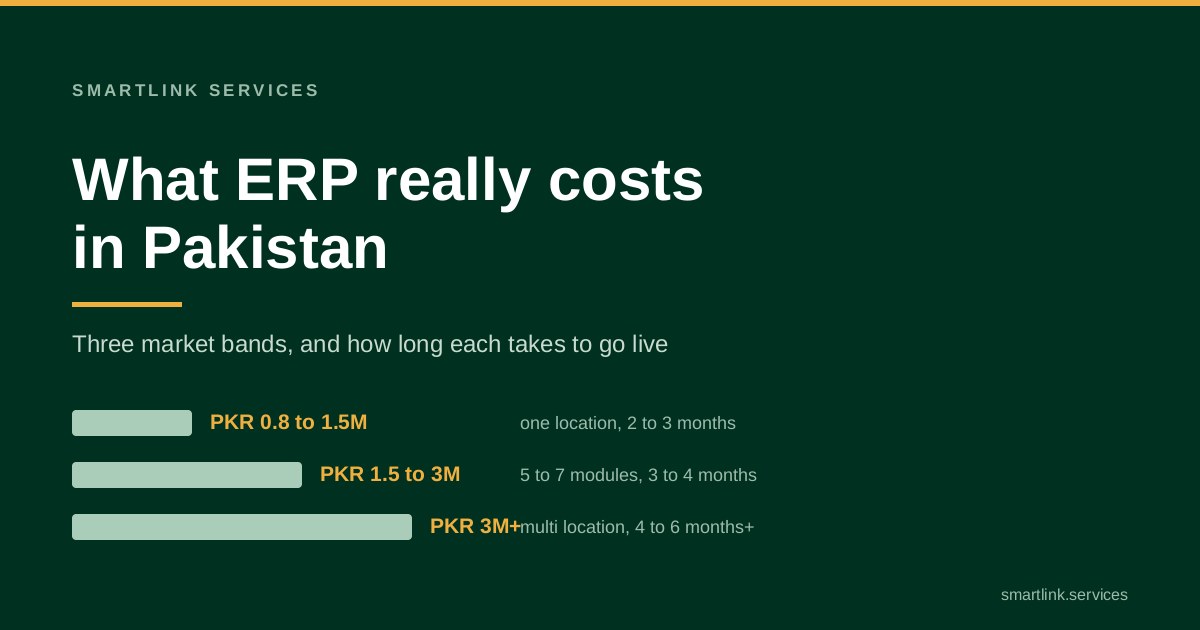
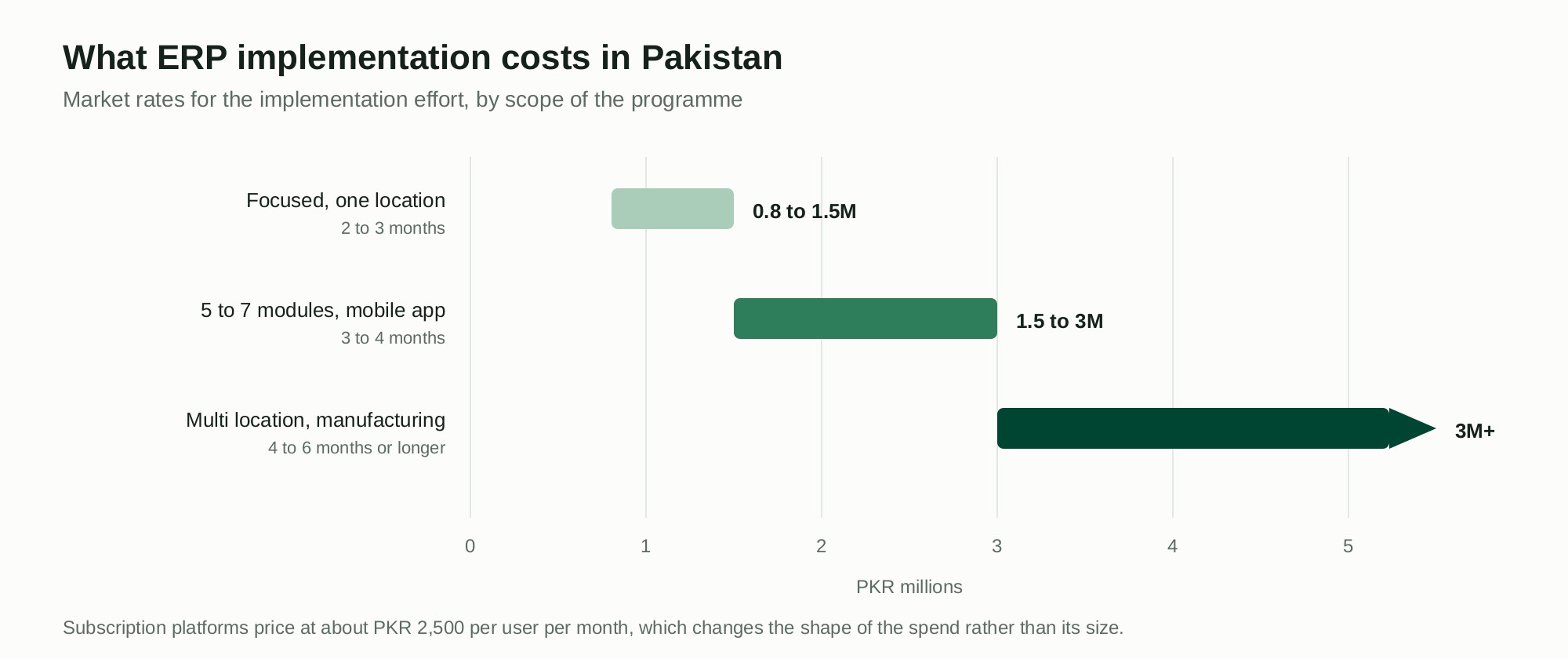
ERP implementation in Pakistan falls into three market bands. A focused implementation covering inventory, sales and purchase at a single location runs PKR 800,000 to 1,500,000 and goes live in two to three months. A mid sized programme of five to seven modules with a mobile application sits at PKR 1,500,000 to 3,000,000 across three to four months. Multi location work with manufacturing and external integrations starts at PKR 3,000,000 and runs four to six months or longer. Where the platform is sold by subscription, the market figure is around PKR 2,500 per user per month, which changes the shape of the spend without changing its size.
Those are the numbers most vendors will not put in writing until you are deep in a sales process. Here is the detail behind them, what pushes your own figure up or down, and how to read a quote so you can tell a fair one from a hopeful one.
What does ERP implementation cost in Pakistan?
Cost tracks the number of process chains you are putting into the system and the number of sites that have to run it, more closely than it tracks industry. A textile mill and a distribution business of similar shape pay broadly similar amounts, because the work is driven by how many end to end paths you are redesigning and how many people have to be trained.
The three bands in detail:
- Focused, single location: PKR 800,000 to 1,500,000, live in two to three months. Inventory, sales and purchase. Little customisation, one site, one legal entity.
- Mid sized, five to seven modules with a mobile application: PKR 1,500,000 to 3,000,000, three to four months. Finance joins operations, approvals move into the system, and field or floor users come on through the app.
- Multi location with manufacturing and external integrations: from PKR 3,000,000, four to six months or longer. Production, planning and quality, stock across locations, and interfaces to plant systems, banks or FBR.
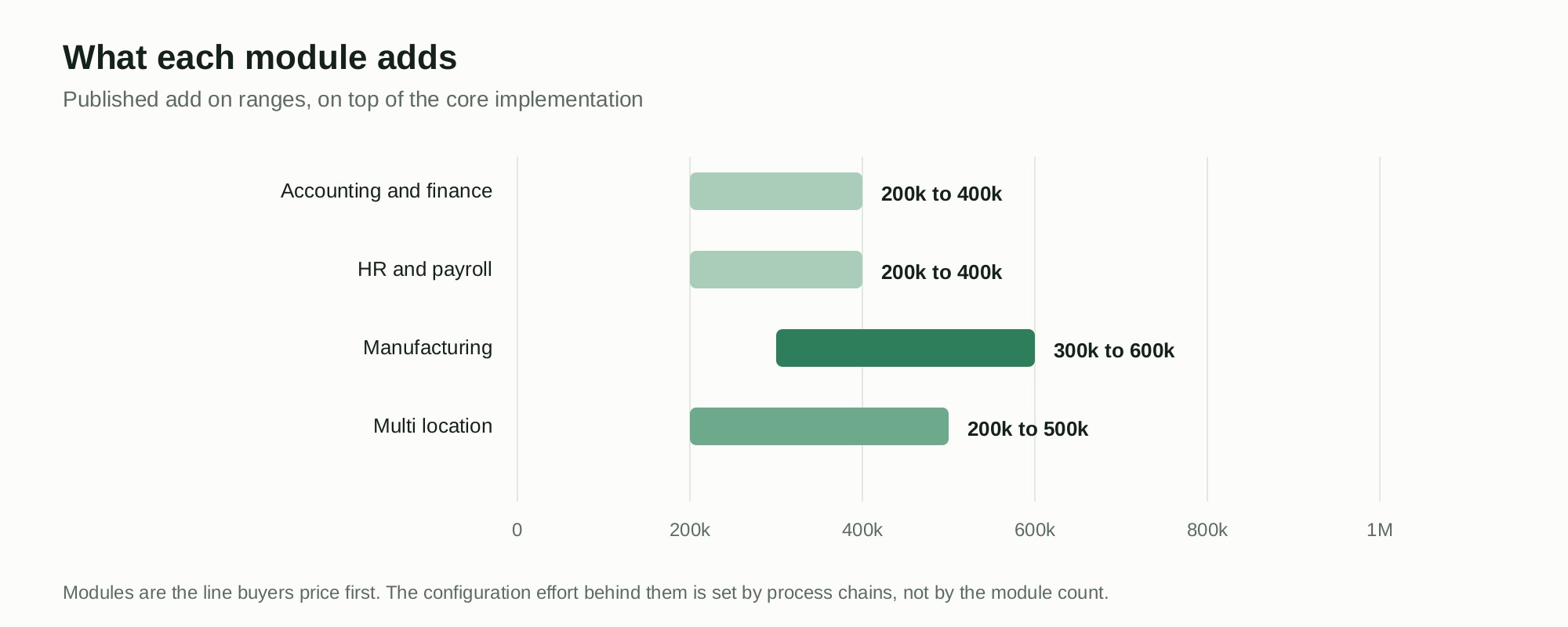
Modules are the line buyers price first. Published add on ranges put accounting and finance at PKR 200,000 to 400,000, HR and payroll at the same, manufacturing at PKR 300,000 to 600,000, and multi location capability at PKR 200,000 to 500,000.
Two caveats. These are implementation figures, which is the effort that makes a licence useful, and they assume a partner does that work. If your own team can genuinely carry the configuration, the lower end of each band is reachable. Most companies that assume this discover their finance and IT people already have full time jobs.
Why is the quoted software price never the final price?
Because a licence quotation prices the software, and the work that makes the software useful is a separate purchase. An honest quotation separates six things, and the first is usually the only one a buyer sees up front.
- Licence or subscription, set by user count and edition
- Configuration effort, set by process chains rather than by the module list
- Data cleansing and migration, priced after the source systems have been profiled
- Each integration costed with its failure handling, not only its happy path
- Training and cutover support
- Support from year two onward
Two of those lines are the ones buyers cut first: data migration and training. They are also the two that decide whether anyone is still using the system in month four. Cutting them does not save money, it moves the cost into next year, where it reappears as duplicate spreadsheets and a finance team still closing the month by hand.
What pushes your own number up?
Seven things account for most of the variation between two companies of the same size.
- Number of legal entities. Each one adds a chart of accounts, a statutory reporting line and an intercompany flow. Two entities is not twice the work of one, but it is not far off.
- How clean your current data is. A item master with duplicate codes, inconsistent units and dead stock entries can add six to ten weeks on its own. This is the single most underestimated line in Pakistani implementations.
- Customisation against configuration. Configuration is settings. Customisation is code, and code has to be retested at every upgrade for the life of the system. Each significant customisation adds to both the build and the running cost.
- Integrations. Attendance hardware, weighbridges, checkweighers, bank files, an existing CRM, FBR digital invoicing. Each interface is a small project with its own testing.
- Statutory payroll. If payroll is in scope, parallel runs are not optional. Expect four to six weeks of running old and new side by side before you can switch.
- Plant connectivity. A site on a weak link needs offline capability or local caching. This is a real cost at remote sites and it is usually found late.
- Who owns the project internally. A dedicated project owner with authority shortens every phase. A committee lengthens all of them.
How long does an ERP implementation take in Pakistan?
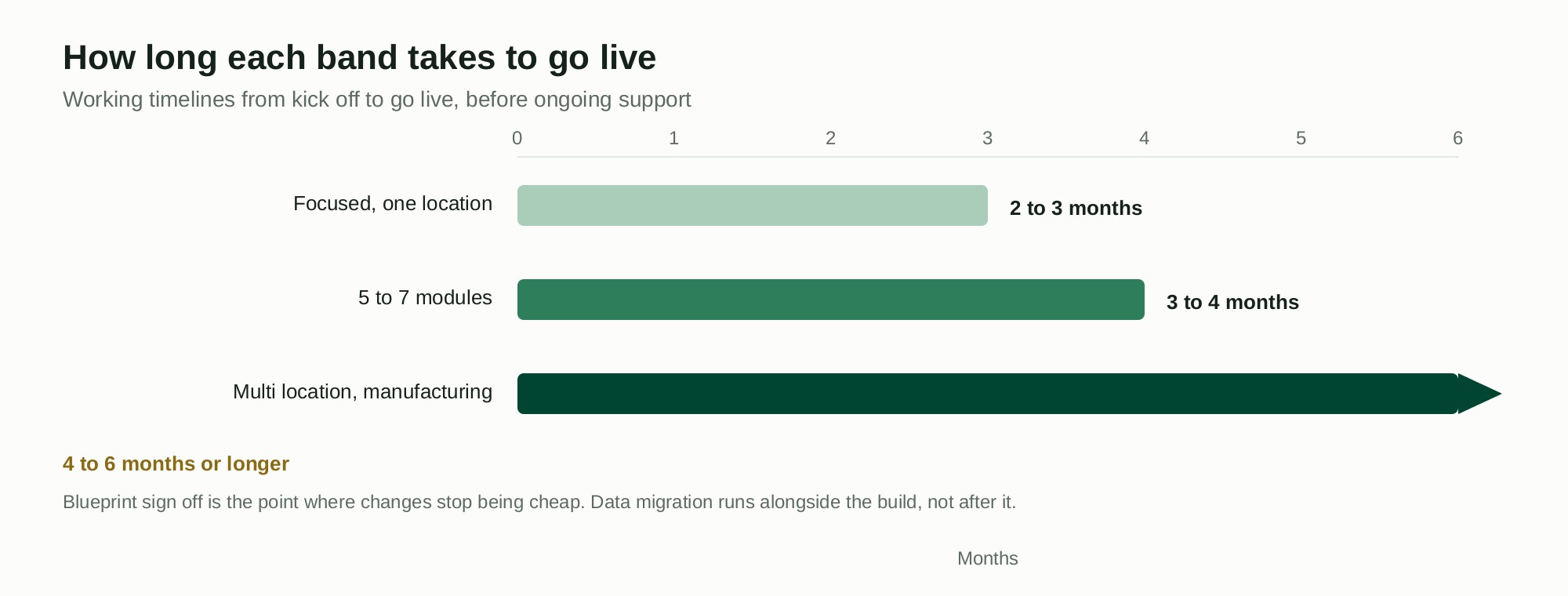
Two to three months for a focused single location implementation. Three to four months for a mid sized programme of five to seven modules. Four to six months or longer once manufacturing and multi location stock are in scope. Those are working timelines to go live, not to the end of support.
Published survey work on small and mid-sized ERP buyers has found projects running roughly six months longer than buyers were told at the outset, and implementation fees landing about a third above what was predicted. Both findings come from vendor-commissioned surveys, so treat the exact figures with care, but the direction is consistent with what happens here when blueprint sign-off slips.
One date matters more than the rest. Blueprint sign-off is the point where changes stop being cheap. Everything agreed before it costs a meeting. Everything changed after it costs rework, retesting and usually a renegotiation.
SAP, Oracle, Odoo or a local product: what each costs here
Platform choice changes your number more than any other single decision, and the honest answer is that the most expensive option is not always the wrong one.
- SAP S/4HANA or Business One. Business One suits 25 to 150 users and lands in the lower two bands. S/4HANA is a tier-one commitment and belongs in the upper bands. You are buying process discipline and a deep local partner pool. Our SAP implementation work sits mostly with manufacturers moving off spreadsheets and older systems.
- Oracle E-Business Suite or Fusion. Common in Pakistani groups that invested a decade ago, which makes the real question upgrade against re-implement rather than buy against not buy. We cover that decision in Oracle ERP and EBS.
- Odoo and similar open platforms. Lower licence cost, genuine flexibility, and a dependency on the quality of your implementer. Cheap to start, expensive to rescue.
- Local and regional products. Strong on local tax handling and cheaper to run, usually weaker on multi-entity consolidation and formal upgrade paths. For single-entity companies this is often the right answer and is dismissed too quickly.
| Platform | Suits | First-year range | Main risk |
|---|---|---|---|
| SAP Business One | Mid sized, one or two sites | PKR 1.5 to 3M | Outgrowing it at group level |
| SAP S/4HANA | Groups, statutory complexity | PKR 3M and up | Scope and change fatigue |
| Oracle EBS or Fusion | Existing Oracle estates | PKR 3M and up | Upgrade priced as re-implementation |
| Odoo and open platforms | Single entity, flexible processes | PKR 0.8 to 3M | Implementer quality decides everything |
| Local and regional products | Single entity, strong local tax needs | PKR 0.8 to 2M | Consolidation and upgrade paths |
If you have not shortlisted yet, do the selection separately from the build and keep the advice independent of who implements it. That is the point of a selection engagement.
Which costs do Pakistani buyers miss most often?
Four, and none of them appear in a standard vendor quote.
FBR digital invoicing integration. Sales tax registered businesses have to issue invoices through the digital invoicing platform, either via a licensed integrator or through PRAL. If your ERP is the system of record for sales, this is an ERP project line item, not an afterthought. Check the current position on the FBR website before you budget, because the notifications have been revised repeatedly and vendor summaries are not reliable.
Compliance is not a Pakistani peculiarity either. We build statutory requirements into factory systems in every market we deliver in, which currently means FBR digital invoicing and sales tax here, VAT and e-invoicing obligations in Saudi Arabia and Oman, and EU invoicing rules in Ireland and Slovenia. The lesson that carries across all of them is the same: a compliance requirement discovered after blueprint sign-off is an expensive change, and one designed in from the start is a configuration decision.
Statutory payroll handling. EOBI, provincial social security, income tax slabs and gratuity all have to be right from the first run. Allow for the parallel runs mentioned above.
Attendance and plant hardware. Biometric devices, weighbridges and line instruments rarely integrate as neatly as the brochure suggests. Budget for the interface and for the testing.
The second year. Support, upgrades and the small change requests that follow go-live typically run at fifteen to twenty percent of the implementation figure, every year. A five-year view is the only honest way to compare two quotes.
What is different about running this project in Karachi?
Four practical things change how a rollout runs here, and all four affect the schedule more than the price.
Plants run continuously. A mill in SITE, Korangi or Port Qasim does not stop for a cutover. Go-live has to land on a shift change, with a stock count that fits between shifts, which usually means a weekend and a rehearsed sequence rather than a convenient Monday. Teams that plan cutover around office hours discover this late.
Power and connectivity need a fallback. Plant-floor terminals that cannot reach the server during an outage will either stop production or create a parallel paper trail that someone has to key in later. Decide in blueprint which transactions must work offline, and test that path properly rather than assuming the generator covers it.
Training is bilingual in practice. Head office users work comfortably in English. Store, production and QC users often do not, and their screens are the ones that produce the data every report depends on. Budget for session notes and floor-level guides in Urdu, and for refresher sessions after the first month rather than one round at go-live.
The calendar has fixed points. A June year end for most companies, Ramadan and both Eids, and the annual audit all constrain when a finance cutover is sensible. Mapping these at the start removes a lot of argument later, and it is one reason a local partner with site teams in the city tends to beat a remote one on schedule even when the day rate looks higher.
How should you budget for it?
Three rules keep a budget intact.
First, set a contingency of fifteen to twenty percent and name what it is for. Academic work on Pakistani ERP projects has reported that over half of them overran their budgets, and unnamed contingency gets spent on scope rather than on risk.
Second, phase deliberately. Finance and inventory first, then production, then analytics. Each phase should produce something people use before the next one starts. Phasing costs slightly more in total and reduces the chance of total failure substantially.
Third, separate what you are buying from what you are changing. A rollout that also redesigns your approval hierarchy, your costing method and your warehouse layout is three projects wearing one budget line. Decide which of them you are actually funding.
When should you not buy an ERP yet?
There are three situations where the right advice is to wait.
If nobody internally owns master data, fix that first. An ERP will industrialise whatever discipline you already have, and it will industrialise the lack of it just as efficiently. If your processes are about to change for a commercial reason, such as a new plant or a merger, implement after the change rather than through it. And if the real problem is one report that nobody can produce, buy a reporting layer over your existing systems and keep the ERP money. We have given all three of these answers to companies that arrived ready to buy. Losing that order costs less than a stalled implementation costs both sides.
How do you read an ERP quote?
Ask for every quote to be itemised on the same eight lines, in rupees, so you can compare them:
- Licences or subscription, with the user count and user type each applies to
- Implementation and configuration, by phase
- Data migration, with the number of mock cycles included
- Each integration, named and priced separately
- Training, with the number of sessions and who delivers them
- First-year support, with response and resolution targets
- Annual cost from year two, stated as a figure rather than a percentage
- What is explicitly out of scope
The eighth line is the one that tells you most. A partner who writes down what is excluded has thought about your project. A partner who leaves it blank has priced a hope.
Who is answering this
The ranges above come from building and supporting these systems rather than from reselling them. SmartLink Services runs ERP, inventory and manufacturing systems for factories in Pakistan, and delivers in Oman, Saudi Arabia, Ireland and Slovenia, with country-specific statutory compliance built into each one. We do not publish client names, so take the numbers on their reasoning rather than on a logo wall, and test them against your own quotes.
Where to start
If you are budgeting for next year, start with scope rather than with vendors. Write down how many entities, sites and users are in, which integrations are mandatory, and what state your master data is in. That document determines your number more than any price list will, and it makes vendor quotes comparable.
We publish costs and timelines on our ERP implementation page for the same reason. If you want a figure for your own scope, tell us what is in it and we will give you a range and the reasoning, before any sales conversation.