
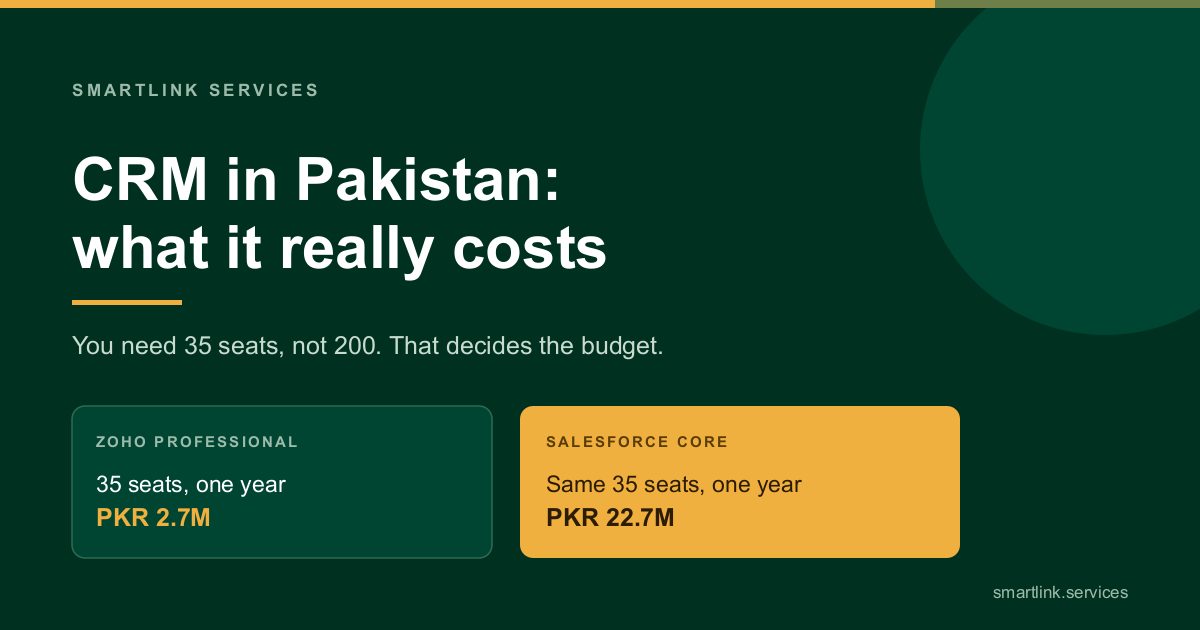
A 200-person company in Pakistan does not need 200 CRM licences. It usually needs 30 to 40, because only the people who touch a customer before the invoice belong in a CRM. At that seat count, list prices run from roughly PKR 1.6 million a year on Zoho Professional to PKR 9.5 million on Salesforce Core, before implementation. Getting the seat count right moves your budget further than choosing between the platforms does.
Every price below was taken from the vendor's own pricing page on 18 November 2026, because the published comparisons disagree with each other and several are quoting tiers that no longer exist.
How many CRM seats does a 200-person company actually need?
This is the question that decides the budget, and almost nobody asks it first. CRM vendors price per user per month, so the seat count multiplies everything. Buy on headcount and you will overpay by a factor of five.
A CRM seat is for someone who owns or advances a customer relationship. In a typical 200-person Pakistani manufacturer or distributor, that is a much smaller group than the org chart suggests.
Work through it by function. Field and inside sales need seats, because they own the pipeline. Sales management needs seats to see the forecast. Customer service or after-sales needs seats if they log complaints against the customer record. Marketing needs a couple if campaigns feed leads in. That is your list.
Finance does not need a seat to raise an invoice, because the invoice belongs in the accounting or ERP system and the integration carries the data across. Production, QC, HR, procurement and the warehouse do not need seats at all. Executives who want to look at a dashboard once a month usually do not need a full licence either, since most platforms have a cheaper read-only or lightweight tier.
For a 200-person business that is commonly 18 to 25 sales and inside sales, 5 to 8 in service, 3 or 4 managers, and a couple in marketing. Call it 35. The exercise takes an afternoon and is the single highest-return hour in the whole selection.
| Function | Needs a seat? | Typical count |
|---|---|---|
| Field sales | Yes, they own the pipeline | 12 to 16 |
| Inside sales and order desk | Yes | 6 to 9 |
| Customer service and after-sales | Yes, if complaints are logged against the customer | 5 to 8 |
| Sales management | Yes, for the forecast | 3 to 4 |
| Marketing | Yes, if campaigns feed leads in | 2 |
| Finance | No, the invoice lives in the ERP | 0 |
| Production, QC, warehouse, HR, procurement | No | 0 |
| Executives wanting a dashboard | Usually a cheaper read-only tier | 0 full seats |
Two refinements are worth making before you sign anything. Count the people who will genuinely log in weekly, not everyone who might one day want to look, because a licence bought for an occasional viewer is paid for twelve months. And check whether your shortlisted platform sells a lower-cost tier for users who only read, since on a 35-seat deployment that can take a fifth of the bill out.
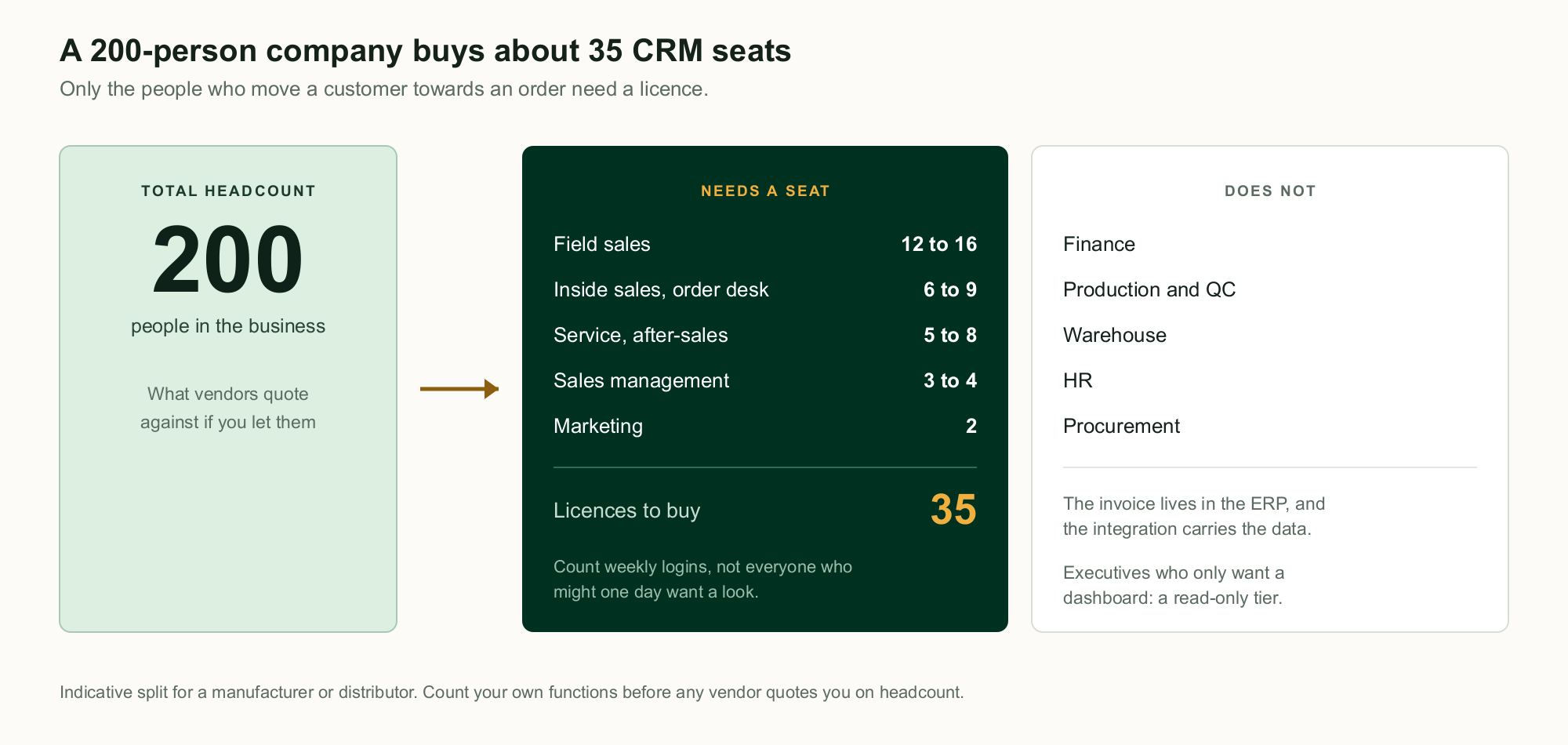
Only the people who move a customer towards an order need a licence. The rest of the business reads the output.
What do the main CRM platforms actually cost?
List prices are per user per month, billed annually, in US dollars. Local taxes are charged on top of these figures.
| Platform | Entry | Mid | Upper | Top |
|---|---|---|---|---|
| Zoho CRM | Standard $14 | Professional $23 | Enterprise $40 | Ultimate $52 |
| HubSpot Sales Hub | Starter $7 | Professional $90 | Enterprise $150 | |
| Salesforce Sales Cloud | Starter Suite $25 | Pro Suite $100 | Core $195 | Advanced $395 |
| Dynamics 365 Sales | Professional $65 | Enterprise $105 | Premium $150 |
Four things in that table are routinely missed.
HubSpot charges a one-time onboarding fee. It is $1,500 on Professional and $3,500 on Enterprise, and it does not appear in any comparison table we could find. On a ten-seat team that fee is larger than the first year of licences on most competitors.
Salesforce renamed its tiers. What older articles call Enterprise is now Core, at $195. If a quote or an article references Salesforce Enterprise pricing, check which tier is actually meant.
Paying monthly costs more. Zoho Enterprise is $40 per user per month on an annual commitment and $50 billed monthly. That is a 25 per cent premium for the flexibility, which is worth paying only during a genuine pilot.
The free tiers are smaller than people think. HubSpot's free tier covers 2 users and Zoho's covers 3. They are fine for testing an idea and not a foundation for a sales team.
What does that look like in rupees?
At 35 seats for twelve months, converted at PKR 277 to the dollar, the interbank rate in mid-November 2026. The open market was nearer 279.5.
| Platform and tier | Per user per month | 35 seats per year |
|---|---|---|
| Zoho Professional | $23 | about PKR 2.7 million |
| Zoho Enterprise | $40 | about PKR 4.7 million |
| Dynamics 365 Sales Enterprise | $105 | about PKR 12.2 million |
| HubSpot Sales Hub Professional | $90 | about PKR 10.5 million, plus onboarding |
| Salesforce Core | $195 | about PKR 22.7 million |
The important property of this table is that none of it is under your control. The bill is set in dollars, so it moves with the exchange rate rather than with your usage. A rupee that weakens by ten per cent raises your CRM cost by ten per cent even if nothing about your business changed. Budget in dollars and convert, rather than fixing a rupee number and being surprised at renewal.
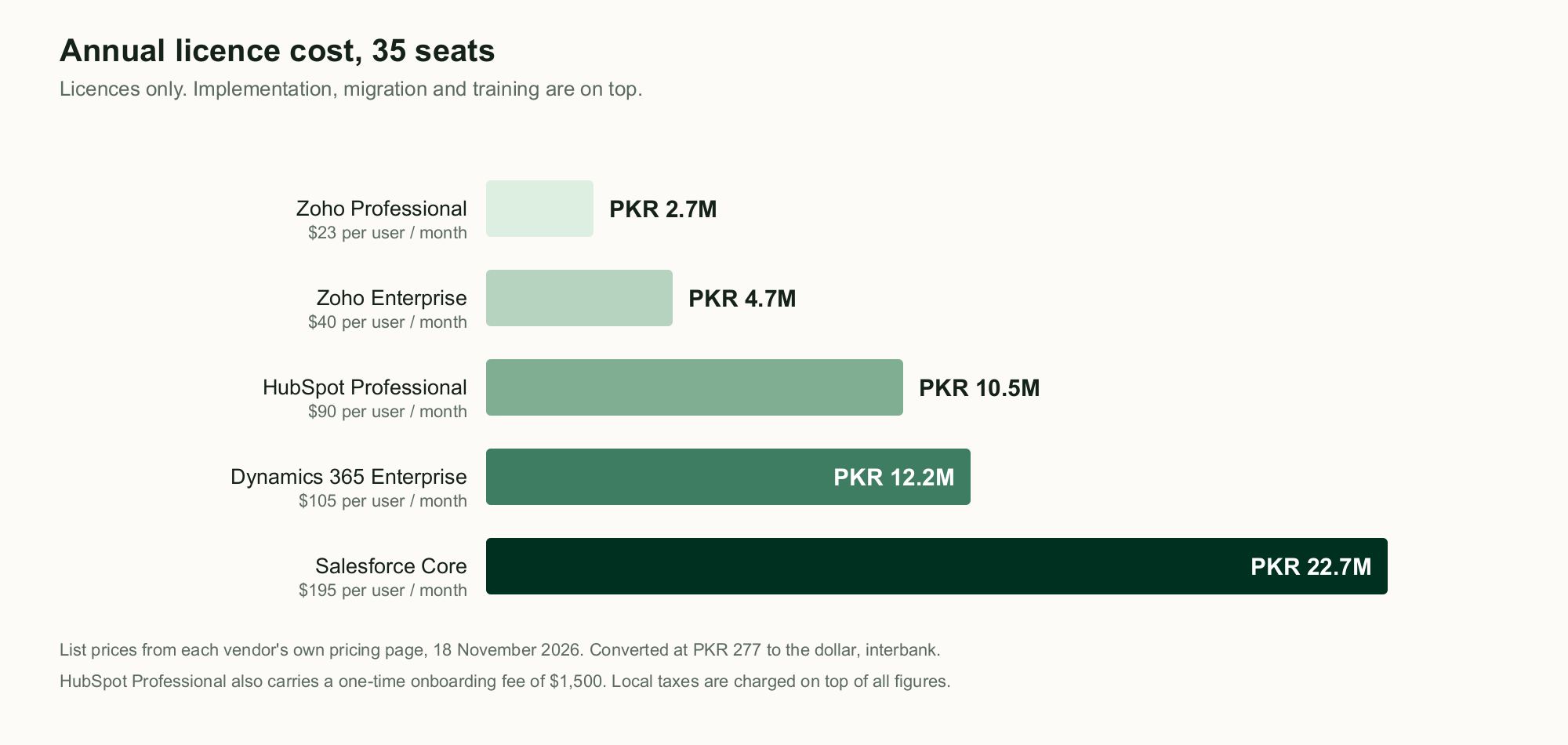
Thirty-five seats for a year, licences only. The spread between the cheapest and the dearest is roughly eight times.
How do you actually pay for it from Pakistan?
This is the part that derails CRM purchases here, and it is not covered in any of the buying guides. A dollar subscription has to be paid across the border, and that is regulated.
Under FE Circular No. 07 of 2022, the State Bank placed an annual limit of USD 30,000 per individual on card-based cross-border transactions, including virtual cards, applied across the whole banking industry. The limit year runs from 1 November.
More importantly for a company, the same circular states that cross-border commercial payments through cards issued to individuals are not permissible. In practice that rules out the common habit of putting the company's software subscriptions on a director's personal credit card. Authorised dealers may issue corporate cards to business customers for this purpose, used in line with the Foreign Exchange Manual and monitored by the bank.
There is also a separate allowance for exactly this kind of spending. Banks have general permission to release up to USD 200,000 per year per company for commercial payments relating to digital services, of which a smaller portion may go to providers that are not on the approved list.
Three practical consequences. Sort the payment method before you sign, because an annual commitment you cannot pay is worse than no CRM. Ask your bank specifically about a corporate card and the digital services route, by name. And if your finance team has been running subscriptions through a personal card, treat moving to a corporate card as part of the project rather than an afterthought.
These circulars date from 2020 and 2022. Confirm the current position with your bank before committing, since foreign exchange rules change more often than software prices.
What does implementation cost on top?
Licences are the visible number. The work around them is usually a similar size in year one, and occasionally larger.
Data migration is first. Customer records in Pakistani businesses tend to live in a mixture of an accounting system, several spreadsheets and the phones of individual salespeople. Consolidating those into one customer master, with duplicates resolved and a decision made about which source wins, is most of the effort on a typical project.
Process mapping is second, and it is the part companies try to skip. A CRM encodes how your sales process works, so somebody has to decide what the stages are, what moves a deal between them, and who owns it at each point. Buying software does not settle those questions, it just makes avoiding them more expensive.
Integration is third. A CRM that does not talk to the system raising the invoice creates double entry and a second version of the truth. The usual link is quotation and order out of the CRM, invoice and payment status back from the ERP integration and interfaces layer. If your invoicing has to satisfy FBR, the handoff matters more, because the document that leaves your system has to carry what a sales tax invoice has to carry.
Then training, and an owner. A CRM without someone whose job includes keeping it clean degrades within two quarters. That is a staffing decision, not a licence.
The shape of this is the same as an ERP budget, where the software is a minority of year one. We set out the full picture in what ERP implementation really costs in Pakistan.
How long does a CRM rollout take?
For a 35-seat deployment on a standard platform, plan for six to twelve weeks from kick-off to a sales team working in it daily. That assumes you are configuring a product rather than building one, and that somebody on your side can make decisions without convening a committee.
The time divides roughly in thirds. The first third is deciding the process and cleaning the customer data, and it is the part that slips, because it depends on your people rather than the implementer's. The second is configuration: stages, fields, permissions, templates and the integration to whatever raises the invoice. The last is migration, training and running the old and new ways in parallel for a short period.
Two things stretch it. A customer master that has never been deduplicated can add weeks on its own, and it is better to find that out in week one than week six, so ask for a record count and a duplicate estimate before anyone quotes. The second is integration to an older accounting system with no usable API, where the work moves from configuration to development.
Rollouts that try to go live across every region and product line on one day tend to go badly. Starting with one team, proving the process works, then extending, costs a little more in elapsed time and considerably less in goodwill.
Which platform suits which kind of company?
Feature grids are not very useful, because all four platforms do the core job competently. The useful question is what shape your business is.
Zoho suits most Pakistani SMEs and mid-market companies, and that is not a compromise choice. The functionality covers a normal sales process comfortably, the price is a fraction of the alternatives, and the gap in capability only starts to matter at genuine enterprise complexity. If you are a distributor, a manufacturer with a sales team, or a services firm under a few hundred people, start here and make the alternatives justify the difference.
Dynamics 365 suits companies already standardised on Microsoft, particularly if you run Business Central or are heading that way. The value is not the CRM in isolation, it is one identity, one security model and a shorter path between the sales record and the finance record.
HubSpot suits marketing-led businesses where the pipeline is fed by content, campaigns and inbound enquiries rather than by field relationships. It is the strongest of the four at that specific job. Remember the onboarding fee when comparing year one.
Salesforce suits genuine enterprise complexity: many business units, complicated territory and approval rules, or a global parent that has already standardised on it. For a single-country company with a straightforward sales motion, you will pay for depth you do not use.
There is also a seat-mixing option that cuts the bill materially. Most platforms allow different tiers for different users, so the eight people who need advanced forecasting can sit on a higher tier while the rest sit lower. Vendors rarely volunteer this.
Should you build a custom CRM instead?
Usually not. A subscription at PKR 2.7 million a year buys a product with a roadmap, a security team and a support line, and reproducing even the basics costs more than that before you have shipped anything useful.
There are real exceptions. If your sales process is genuinely unusual, for example dealer and sub-dealer hierarchies with credit limits and territory rules that no standard pipeline models, configuration can cost more than building. If data residency is a hard contractual requirement for a government or defence client, hosting location may decide it. And if the CRM is really an extension of a system you already run, building the customer-facing part into that platform is sometimes cleaner than bolting a second system alongside it.
Those are narrow cases. The honest test is whether you have tried to configure a standard platform and hit a wall, or whether you are assuming you are unusual. Most companies that believe their sales process is unique have simply never written it down. If you have genuinely hit that wall, CRM implementation work and a custom build are both on the table, and the comparison should be made with real numbers rather than instinct.
Why do CRM projects fail here specifically?
Rarely because the software was wrong. The failures cluster around three things.
The sales team already works on WhatsApp. Enquiries, negotiations and commitments all live in chat threads on individual phones. A CRM asks people to re-enter that in a form, and unless entering it buys them something, they will not. The projects that work make the CRM the place the salesperson gets something back, typically their own follow-up list, their targets, and a price or stock answer they would otherwise have to ring someone for.
Nobody owns the data after go-live. The implementer leaves, the champion is promoted, and six months later half the open opportunities have a close date in the past. One named person has to own pipeline hygiene as part of their job description.
Management does not use the output. If the weekly sales meeting still runs off a spreadsheet somebody compiled by hand, the CRM is a parallel chore and the team is right to ignore it. The fastest way to drive adoption is to make the CRM dashboard the only version of the forecast anyone discusses.
There is a measurable version of this worth agreeing before you start. Pick two or three numbers that will tell you honestly whether the thing is being used: the share of open opportunities with a close date in the future, the share of enquiries that reached the CRM within a day, and whether the forecast in the system matches what the sales director believes. Review them monthly for the first two quarters. If they are poor, the problem is adoption and no amount of reconfiguration will fix it.
One thing worth saying plainly
If nobody in your business currently owns the sales pipeline, do not buy a CRM yet. Software records a process, it does not create one. A company with no agreed stages, no definition of a qualified lead and no single person accountable for the forecast will get a tidier version of its existing confusion, at PKR 2.7 million a year.
Spend the first month deciding who owns the pipeline and what the stages are. You can do that on a whiteboard. If it turns out you cannot agree, that is extremely useful information, and it is a great deal cheaper to learn before the annual commitment than after it. Then pick the platform, and look at CRM systems with a specification rather than a demo.
Prices were taken from the vendors' own pricing pages on 18 November 2026: Salesforce's published Sales Cloud pricing and Microsoft's Dynamics 365 Sales pricing, with Zoho and HubSpot taken from their own pricing and comparison pages. Payment rules are from FE Circular No. 07 of 2022. Vendor prices and foreign exchange rules both change: confirm current figures before committing.